On Assignment: Sinners and One Battle After Another
Hi, everyone. It is the end of the year already, and I’ve been spending most of my time filling out job applications, transforming into a night owl (been going to bed at eight a.m. and waking up at 3 p.m. – I can’t explain to you how this happened), and doing movie stuff. Much of it is currently unpaid, but hopefully that will change soon.
In this entry, I’d like to take the time to write about an interesting phenomenon I’ve noticed over the past few years. It started when I was living in Los Angeles and I’d go to the New Beverly theater. The New Bev’s website says, “All Shows Presented in Glorious 35mm (unless noted in 16mm)”. For a long time I was like, “what does that mean? 35 millimeter? Who cares?”

Screenshot of the New Bev website with writing from yours truly
The film versus digital debate was coming into prominence right as I was starting to seriously consider a career in film and television. My university film education never touched on the merits of one format over another, but I was hanging out with cinephiles who could tell you the difference between a celluloid and digital image within five seconds of a viewing. I still remember going to see Paul Thomas Anderson’s The Master on 70mm and being astonished by the ocean’s vibrant colors in the opening shot. In those moments, I’d swear there was a difference between shooting on film and shooting digitally, even if I couldn’t explain it. I’d never seen colors and brightness in an image like that.

Imagine this with at least a hundred times more brightness and clarity.
Opening shot of The Master (Annapurna/Ghoulardi)
In the thirteen years since The Master was released, some filmmakers with enough clout are making the deliberate choice to shoot on filmstock, even with the advances in camera technology that can make shooting a movie digitally cheaper. For example, Sinnners, directed by Ryan Coogler and with cinematography by Autumn Durald Arkapaw, was shot on 65mm film. Autumn went on record as saying that Coogler thought that the format would be great for “capturing the wide vistas and emphasizing landscape of the Mississippi Delta.” With popular and critically acclaimed movies like Fruitvale Station, Creed, and Black Panther under his belt, Coogler was in the enviable position of being able to have a tighter grip over the aesthetic concerns of the film. Shooting on film, and particularly the 65mm format, was a deliberate choice – the subtext being that there could be no better way of capturing this movie, of telling this story for the screen (because cinematic storytelling is visual storytelling, so the types of cameras, formats, and lenses you choose affect the look and by extension the feel of the movie).
If shooting a movie on a specific format is influential to how the movie looks, seeing a movie projected in the specific format in which a movie was shot could affect how the movie feels. But how much? With notable directors taking a stand on the superiority of the film format in both the making and consumption of a movie, people in cities like New York and Los Angeles now have the option of finding out. Warner Brothers has generated publicity out of the exclusive windows in which people can see Sinners on IMAX 70mm film, the format that most closely reflects how this movie was shot (a note that movies shot in 65mm are projected in 70mm to account for the soundtrack).
As a result of this filmmaking ethos and associated marketing making its way into the mainstream, people are now asking if they should skip work to see a screening, and driving (or flying) hours across state lines to see the movie at an IMAX because it’s the only theater showing the movie in this format for hundreds of miles. Access to films is also a huge part of the health of the medium, and while I have no complaints about people connecting more deeply with it or a movie itself (especially a good one), I’m wondering how many people we’re leaving out with these limited viewing windows and locations. A cinephile in Kentucky deserves to see a movie like Sinners in the most ideal viewing circumstances possible as much as a cinephile from New York – possibly not more, as a cinephile from New York gets to experience all sorts of movies in all sorts of formats because of the cinema infrastructure and culture there.
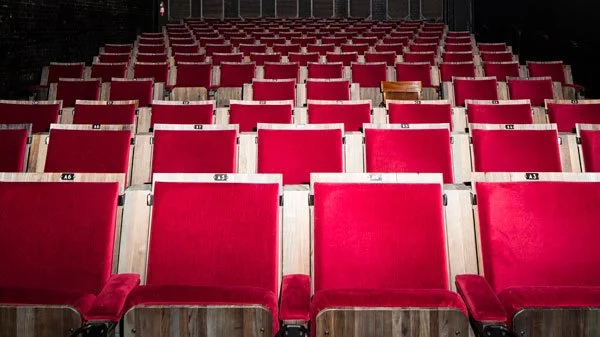
The Metrograph in NYC and its luscious, red velvety seats (Photo: Jeremy Leibman)
What I decided to do, for my own filmmaking education and maybe even offer an informed opinion for anyone who might read this, is see Sinners and Paul Thomas Anderson’s One Battle After Another – another critically lauded and popular movie this year – in two separate viewing formats each. I saw both movies projected in the closest film format used to record the footage (IMAX 70mm for Sinners, VistaVision for One Battle After Another) and I also saw both movies screened digitally, at separate theaters. Again the goal of this was to see for myself how much seeing the film closest to its recorded format affects my cinematic perception of the story – will I still feel as engaged in critical parts of One Battle After Another if I view I in a 2:39 DCP versus VistaVision film? Will I feel like I’m missing something from the viewing experience? Will others be missing something from the viewing experience who can’t make it to one of the four theaters in the world showing One Battle After Another in its original film format?
A note: I viewed all of these movies between September and November 2025, and while these movies and their film formats may be older news, I do think that these viewing experiences will have some relevance for cinemagoers in the future who are on the fence about going to see a VistaVision screening of a film they’re really excited about, or who might be concerned they’ll miss a historic cinematic event when a movie screens on a specific kind of film stock and they’re five states away in all directions from any theater in which to see it.
MY NOTES
1. Movie: One Battle After Another
Projection: DCP (digital) format, scanned from the VistaVision negative
Where: AMC Dolby Cinema
Verdict: I can’t remember if I knew that One Battle After Another was so heavily action-oriented going in – it’s not like you could really tell what kind of movie it was going to be from the trailers. However, I was very glad I chose an AMC Dolby Cinema for this viewing, which uses a different sound and projection system than a regular movie theater. For this viewing, even though the movie was recorded on film and I was watching it in digital, I thought the images looked beautiful (from a modest cinephile’s perspective). I think that some beautiful work was done in camera by Anderson and Michael Bauman to give One Battle After Another a particular look and feel that influences viewers’ emotional experiences and further engages us with the story, and I think I would have felt this way regardless of how I was watching the movie projected. However, I think my experience of the sound – the crispness of gunfire, the growl of the car engines – was only enhanced due to Dolby’s unique sound system, and I think the brightness and clarity of the Dolby screen added another layer of resonance to the vivid colors of the desert in the movie’s final half hour (also, I found out in the course of writing this that Dolby technology is actually used by the Director’s Guild of America to screen movies for industry professionals, so that’s pretty cool).
However, had I seen One Battle After Another in a regular theater, with a less pristine sound and screen, I think I would have still been quite taken with this movie due to the excellent screenplay, masterful direction, top-notch performances, rich characters, and story.
2. Movie: Sinners
Projection: IMAX 70mm film
Where: Universal City Walk IMAX
Verdict: There could be a separate article on the qualities that distinguish an IMAX viewing from a Dolby viewing, but again, this screening was the closest to seeing Ryan Coogler’s vision for the movie, since it would be projected in the format in which it was shot. And the IMAX film format adds a realness, majesty, and splendor to those landscapes of the Mississippi, just like Coogler wanted. During this viewing, as the main characters were moving from place to place trying to get everyone to come to their juke joint, I seemed to feel the dirt from the ground on my skin, and it seemed to bake in the air as I was watching the movie. And graininess of the film stock infused my viewing of Sinners with a realism that made both the geography and time period seem more immediate, visceral.
The same goes for the incredible sound. I can’t find too much concrete information on what exactly distinguishes this sound system in this theater from another, but I was so taken aback by how good the sound was. I don’t think I’d be too off base by describing Sinners as a music movie – at the very least, its relationship to music is quite strong, and this was only something I found out as I was watch it. I was not expecting the stirring performance sequences, and the sound system at this theater was ideal for hearing and feeling the energy of the juke joint. When the characters started dancing and stomping on the wood floor, it felt like my heart and soul was right underneath the floorboards. The singing, enhanced by the wonderful sound mixing and design, seemed to howl and reach for the moon. I can’t really describe it as anything short of rapturous. I would see any movie that prominently features music at this theater over and over.
However, had I seen Sinners in a regular theater, with a less pristine sound and screen, I think I would have still been quite taken with this movie due to the excellent screenplay, masterful direction, top-notch performances, rich characters, and story.
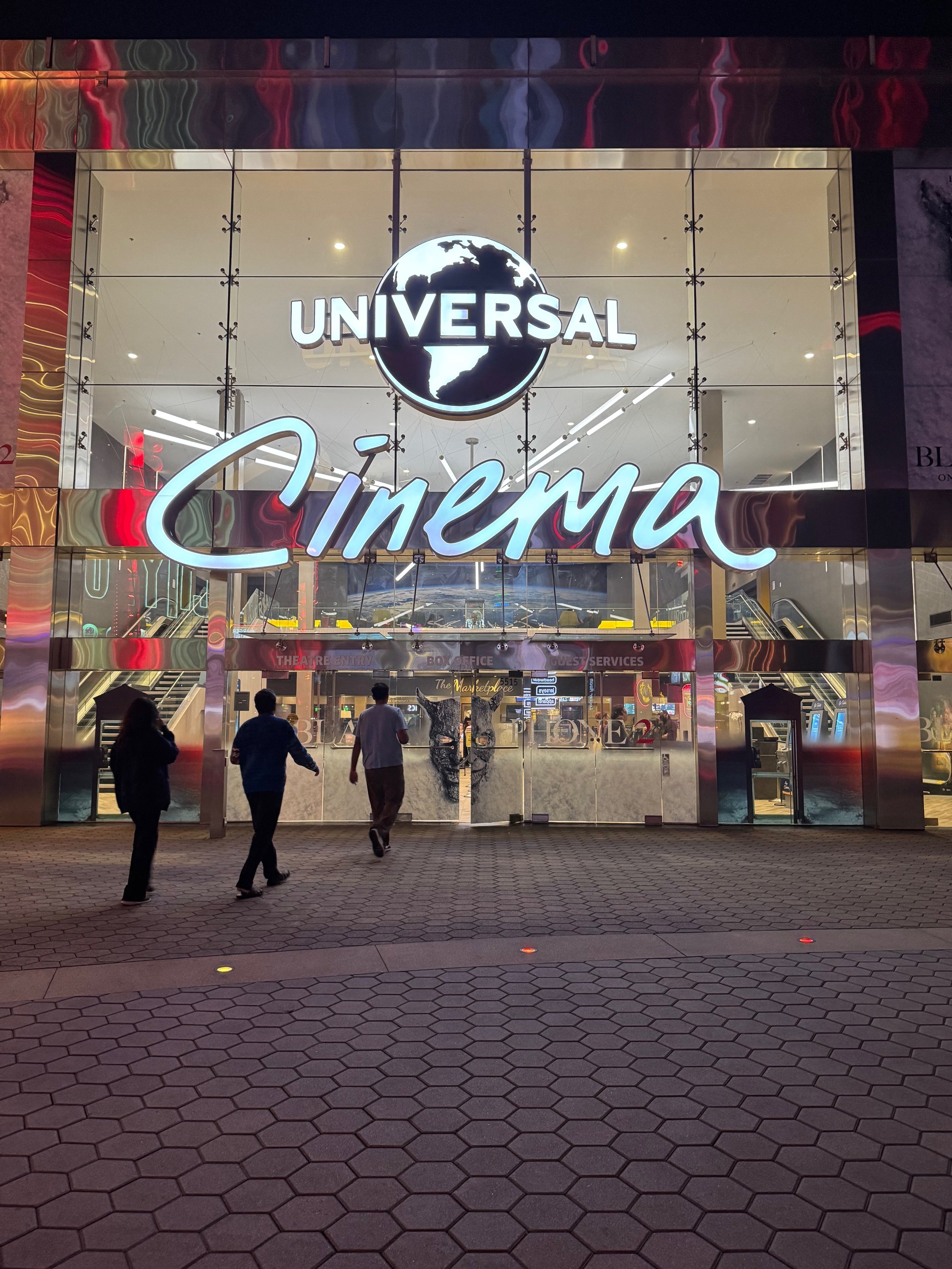
The entrance of the AMC Universal Citywalk Theater at night (Photo: myself)
3. Movie: Sinners
Projection: IMAX DCP
Where: Regal Entertainment Multiplex
Verdict: I saw this two days after my Sinners IMAX 70mm screening. And I left feeling quite befuddled, because the sound and screening quality of this IMAX was so inferior to the one at Universal Citywalk. The screen was darker; the sound was less resonant. And, in this modest cinephile’s opinion, the scenes of the Mississippi Delta that so captivated me during the 70mm film projection felt less immediate digitally. In my opinion, the lack of grain that you can find a film stock took away an element of life from the image and severed that connection with the movie.
However, even on a less pristine sound and screen, I was still quite taken with Sinners due to the excellent screenplay, masterful direction, top-notch performances, rich characters, and story. I had no regrets seeing this twice, and a second viewing of Sinners on any IMAX screen provides a wonderful way to look for and notice details of the movie that escape you the first time around.
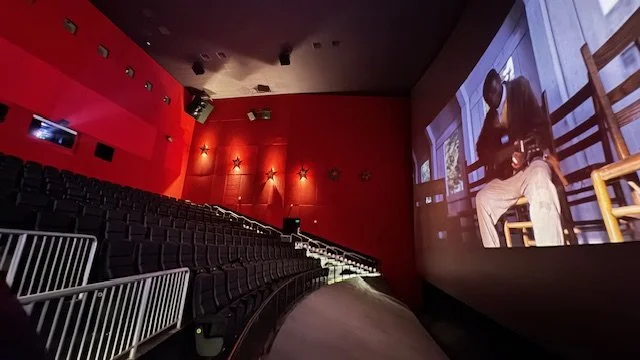
The interior of the IMAX where I saw Sinners, and I was the only one on hand for this final scene, so I had to take a photo (apologies for the crappy resolution)
4. Movie: One Battle After Another
Projection: VistaVision
Where: Vista Theater (Los Angeles)
Verdict: I need to admit – I could hardly tell how the larger format enhanced my experience of the film. At the risk of contradicting myself, an enhanced aspect ratio and richness to the colors was certainly there (most noticeable to this humble cinephile during the scene featured at 0:20 in this video), but what I was more captivated by was the historic theater in which I was watching this movie. The Vista is such a unique theater, with a resplendent Egyptian-themed interior. With such a historic feel, The Vista’s screening environment is perfect for watching movies that have some throwback to some prior age of moviemaking. And the sound system in here absolutely did the movie justice.
And even though this viewing format contained merits I was less able to detect due to my limited cinematic eye and experience, I was still quite taken with One Battle After Another due to the excellent screenplay, masterful direction, top-notch performances, rich characters, and story.
IN CONCLUSION
If the filmmakers do their jobs and tell a story well for the silver screen, the choice of format, projection system, and theater will not make or break your viewing. What’s created and captured during the production process will be truly be what decides whether you’re pulled into the film or not. Everything else – even if it’s only shown in London – is just window dressing. So if you want to see a movie, just go see a movie. I’m sure seeing it in theaters will please any director and hopefully add an enlarged dimension to the viewing experience that comes from the screen alone, whether the movie’s in 70mm film, or not.