Ryland Grace and the Reappearance of the Ordinary Man in Cinema
Cinemagoers have been living in the shadow of superhero movies for nearly twenty years. We have three upcoming superhero movies this year: Supergirl, Spider-Man: Brand New Day, and Avengers: Doomsday. Never mind these are only Marvel movies; it turns out I’d accidentally omitted Masters of the Universe and Legend of the White Dragon. At the time of this writing, He-Man has gotten better reviews than I expected. Apparently, the cast is very good. Though I should say, He-Man will always be associated with this for me.
Since the rise of Iron Man in 2008, the movies have been filled with extraordinary people doing extraordinary things. All the time. The superheroes are usually the smartest, strongest, bravest people in the room. Okay, so what’s the problem? Superheroes blowing stuff up, landing the romantic relationship, and saving the world certainly make for some of the most exciting scenes in movies. What exactly is the problem if there’s entertainment onscreen in an entertainment medium? Am I becoming a cinematic curmudgeon? Ow, my back!
I don’t have a problem with superhero movies. I did take an issue with their hegemonic dominance over moviegoing culture for a while, how it seemed like these were the only movies that were getting made, which isn’t the fault of the films themselves. But I grew up with films like Stand by Me, Hoosiers, The Shawshank Redemption, and Running on Empty, with ordinary people facing extraordinary circumstances. As such, I’ve been craving a less empowered touch regarding the human portrayals I’ve been seeing onscreen.
Project Hail Mary
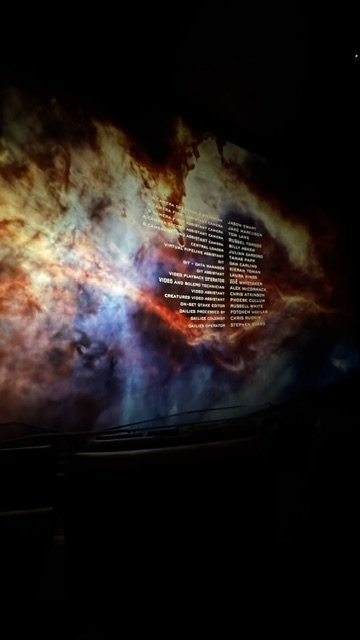
Project Hail Mary hit me quite hard when I saw it last month. I could not believe the ecstatic reviews it was getting. I was concerned the marketing team at Amazon MGM had paid hosts of influencers to wax rhapsodic about the film to get butts in seats opening weekend, a tactic that has already been tried by a studio. Then the excellent reviews kept coming, and I felt I had no choice but to see it while it was still in theaters. I write about cinema, I want to make cinema that mass audiences see, and so I wanted to experience this in a communal setting. I indulged myself in seeing it in IMAX (which is absolutely not necessary to enjoy the film; I think my ticket at the New York AMC was something like thirty bucks, but I don’t regret the decision to see it in this format (especially as viewing the end credits made me feel like I was sitting in the cosmos).
However, the size of the screen has nothing to do with the character of Ryland Grace or Ryan Gosling’s performance. Grace is a middle-school science teacher. Through scenes that take place in the classroom, he seems to be a thoughtful educator, facilitating his students’ understanding of the solar system in a meaningful way. How he conducts himself in class makes you want to root for him, you care about him. Also, there’s something refreshing about seeing someone in the teaching profession onscreen simply teaching, and doing it well, without the scenes having to function as a moment of epiphany for other characters. These moments in the movie not only feel very real; they’re also engaging for audiences.
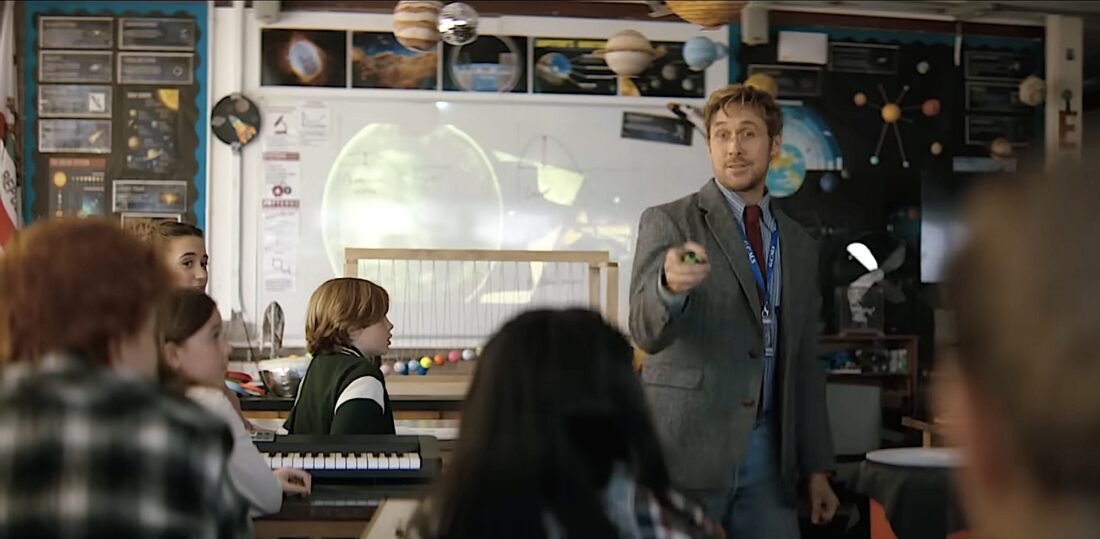
Ryland Grace’s classroom seems like a stimulating place to engage middle-schoolers in thoughtful discussions about universal physics. (MGM Studios)
The students function as ciphers for moviegoers, so that their curiosity at the way the universe works becomes ours, and their bourgeoning understanding becomes ours as well. And the dialogue and Ryan Gosling’s performance in this section grounds the material so that his teaching and the film’s explaining of universal physics doesn’t come across as condescending. These scenes and others in the movie make us feel like a part of the team that is actively solving the narrative’s central problem. Rather than solely being passive participants, we’re engaged with the film on a new level.
The movie emphasizes Grace’s kindness, empathy, curiosity, respect for others, and humility as traits that allow him to succeed in this story, more so than his singular intelligence. The movie’s opening, in which Grace explores the spacecraft in which he’s found himself, functions as a character introduction for the audience. Through humor, heart, and tenacity, Grace learns more about the ship and how he came to be there. The aforementioned qualities also allow him to successfully connect with students as an educator, not to mention the alien aboard his spacecraft. And while making a linguistic program to understand Rocky requires serious technical knowledge, his willingness to collaborate with his newfound friend, and the thoughtful, compassionate, respectful way he approaches this task, are crucial in his journey to save the Earth. While his extraordinary intelligence and courage are on full display in climactic scenes, he gets to these points in the story through qualities that all humans share, and which can’t be measured.
Movie characters define themselves through their actions. Through these actions, they tell audiences who they are, what humanity is capable of achieving, and what’s important to the human condition. If Atticus Finch can stand up for what’s right in the face of overwhelming opposition, maybe we can find that same courage within ourselves to do the same. If Joel can fight for his memories of Clementine as they’re being erased, maybe we’re reminded of how some memories of a significant other are worth keeping, even after a bad breakup. If Clarice Starling can confront evil and bring a serial killer to justice, maybe we as a species are capable of such bravery (even if we don’t have the skills of F.B.I. agents). And seeing these characters demonstrate compassion, kindness, courage, perseverance, inclusion, and other very human qualities on their way to reaching their goals reminds us of the power of these qualities in our daily lives. The same goes for villains, actually. A character consumed by greed like Daniel Plainview reminds us of the cost of that in real life.
While Ryland Grace is extraordinary in many ways, his overall humanity endears him to us as an audience. His responses to problems are rooted in qualities that we all share, and values that represent us at our best. Yet we don’t have to be extraordinary to display kindness, generosity, respect, compassion, and other positive values. Just demonstrating these at all makes us human, but in Project Hail Mary, they help Ryland Grace to commandeer a spaceship, befriend an alien, and ultimately save the world.